// Article · Definition
What is agentic AI?
This article defines agentic AI for executives, operators, and technical stakeholders — in language that requires no prior AI expertise. It sets out the core terms, a governed workflow example, distinctions from chatbots and RPA, measurable value, and how multi-agent programmes are deployed across security, logistics, product, procurement, and compliance.
Agentic AI is software that can plan, reason, use approved tools, and execute multi-step workflows under governed human oversight — not a single conversational reply from a chat interface.
Core terminology
The following terms appear in vendor materials, board papers, and procurement packs. Each corresponds to a concrete element in your operating environment.
- Agent — software assigned to progress a defined goal on your behalf. It is typically powered by a large language model (LLM) and connected only to approved tools and data sources.
- Large language model (LLM) — a model trained on language that helps the agent interpret requests, documents, and context. It does not replace your CRM, ERP, policies, or control framework.
- Multi-step workflow — a sequenced set of actions toward an outcome: receive input, retrieve evidence, draft output, update a record, escalate an exception.
- Tools — governed connections the agent may invoke: APIs into CRM, ticketing, ERP, TMS, SIEM, document stores, or internal knowledge bases.
- System of record — the authoritative system where work is logged and auditable: service desk, CRM, ERP, compliance repository, or engagement record. Agentic delivery should write here — not to parallel spreadsheets.
- Governed human oversight — defined checkpoints at which a person must review, approve, override, or assume control when risk, policy, or confidence thresholds require it.
A baseline workflow example
Consider a routine customer-support email. A member of staff reads the message, interprets intent, consults internal guidance, drafts a response, and either sends it or routes it for review. That is a small, well-understood workflow.
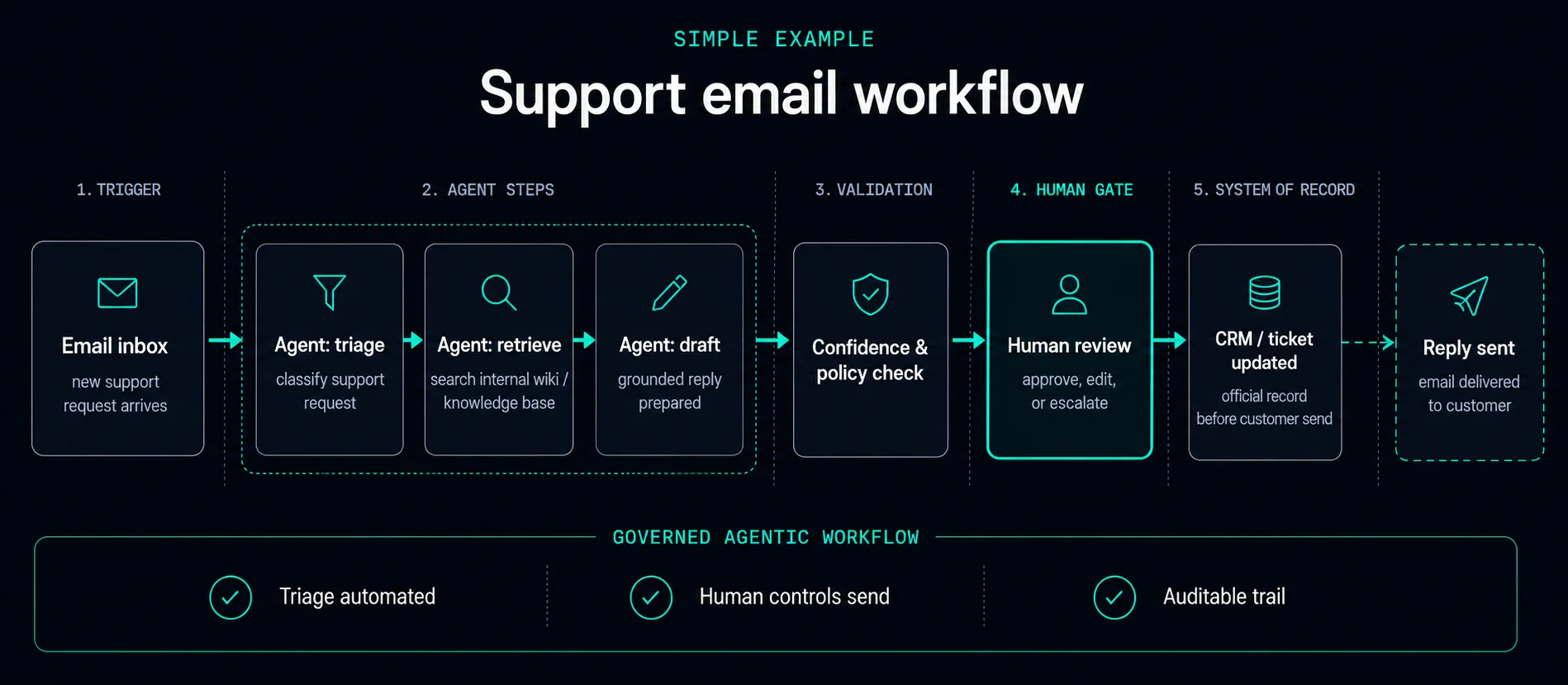
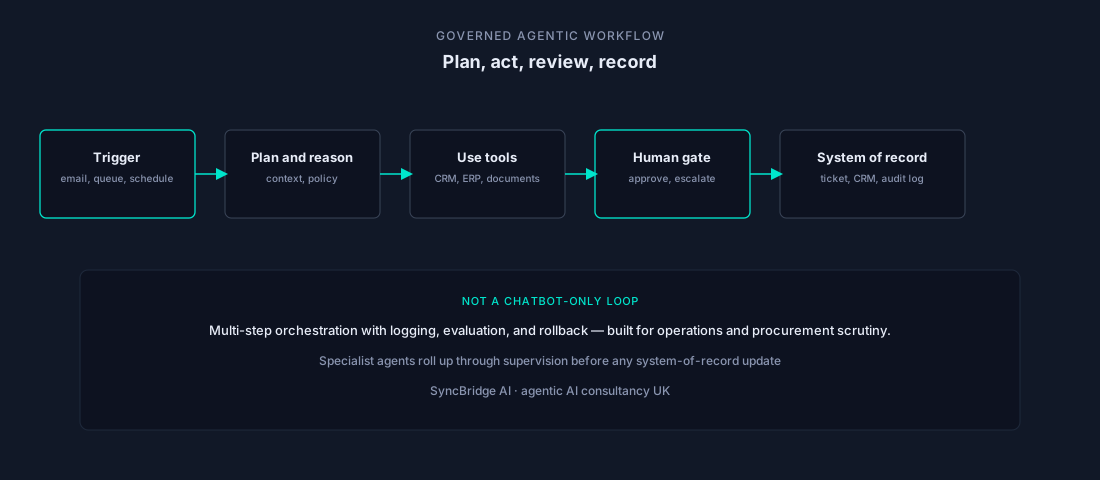
Agentic AI supports the same operating pattern under governance:
- An agent monitors the inbox and classifies a likely support request.
- It invokes tools to retrieve approved content from your knowledge base and drafts a grounded reply.
- According to your risk rules, it escalates to a human for approval or updates the system of record — for example a CRM or ticketing platform — before any customer-facing action is taken.
The distinction is material: this is not a standalone chat response. It is a governed sequence of steps that advances work inside your systems.
Reference architecture
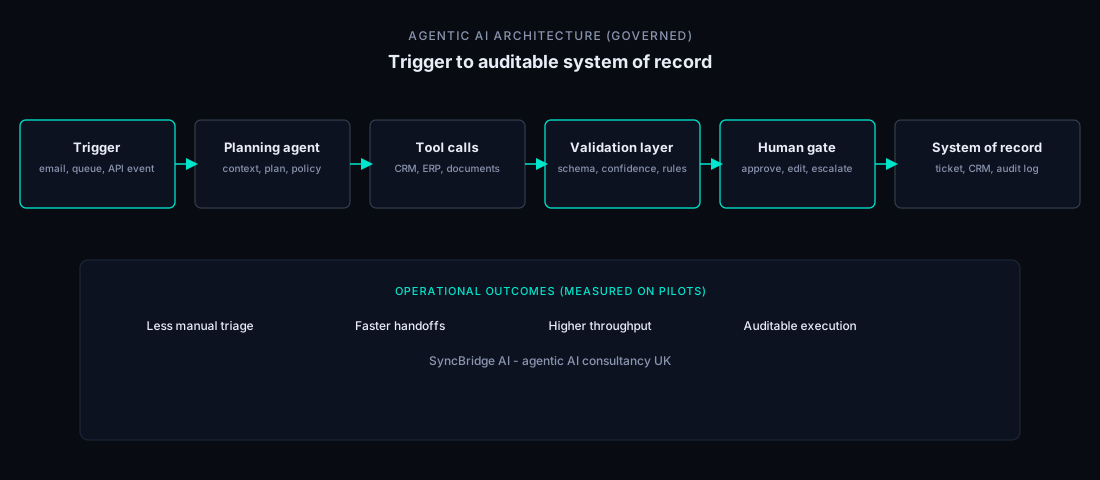
You do not need to internalise this model before a first pilot. It is useful, however, when assessing vendor claims or designing a control environment. A typical governed stack comprises:
- Trigger — an event that initiates the workflow: inbound email, document upload, form submission, alert, or scheduled run.
- Planning — a step that determines the next permitted action within policy boundaries.
- Tool calls — retrieval from, or action within, connected systems of record and approved data sources.
- Validation — checks on schema, confidence, policy fit, and completeness before material steps proceed.
- Human gates — mandatory review on sensitive actions: customer communication, financial commitment, security activity, or policy exception.
- System of record update — the auditable log of what occurred, on what evidence, and under whose authority.
Agentic AI and chatbots: a material distinction
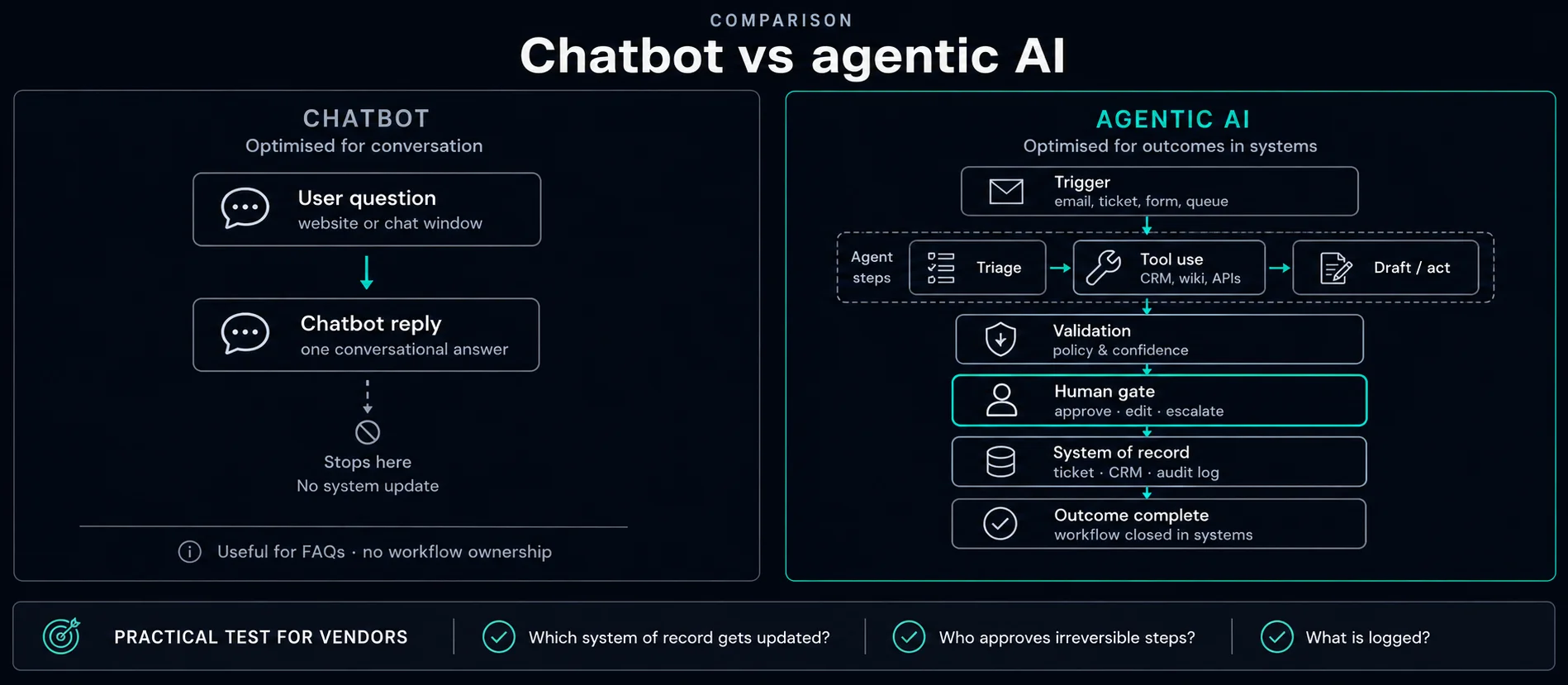
A chatbot is optimised for conversational exchange: input received, response returned. That has legitimate use in FAQs, guided web support, and internal knowledge access.
Agentic AI is optimised for operational outcomes: triage the case, prepare the draft, update the ticket, escalate the exception — with an auditable record of each step.
Market confusion arises when conversational products are labelled “agents.” Three questions cut through it: Which system of record is updated? Who approves irreversible actions? What is logged? If the answers are indeterminate, the capability is conversational software — not governed agentic delivery.
Agentic AI and RPA: complementary, not equivalent
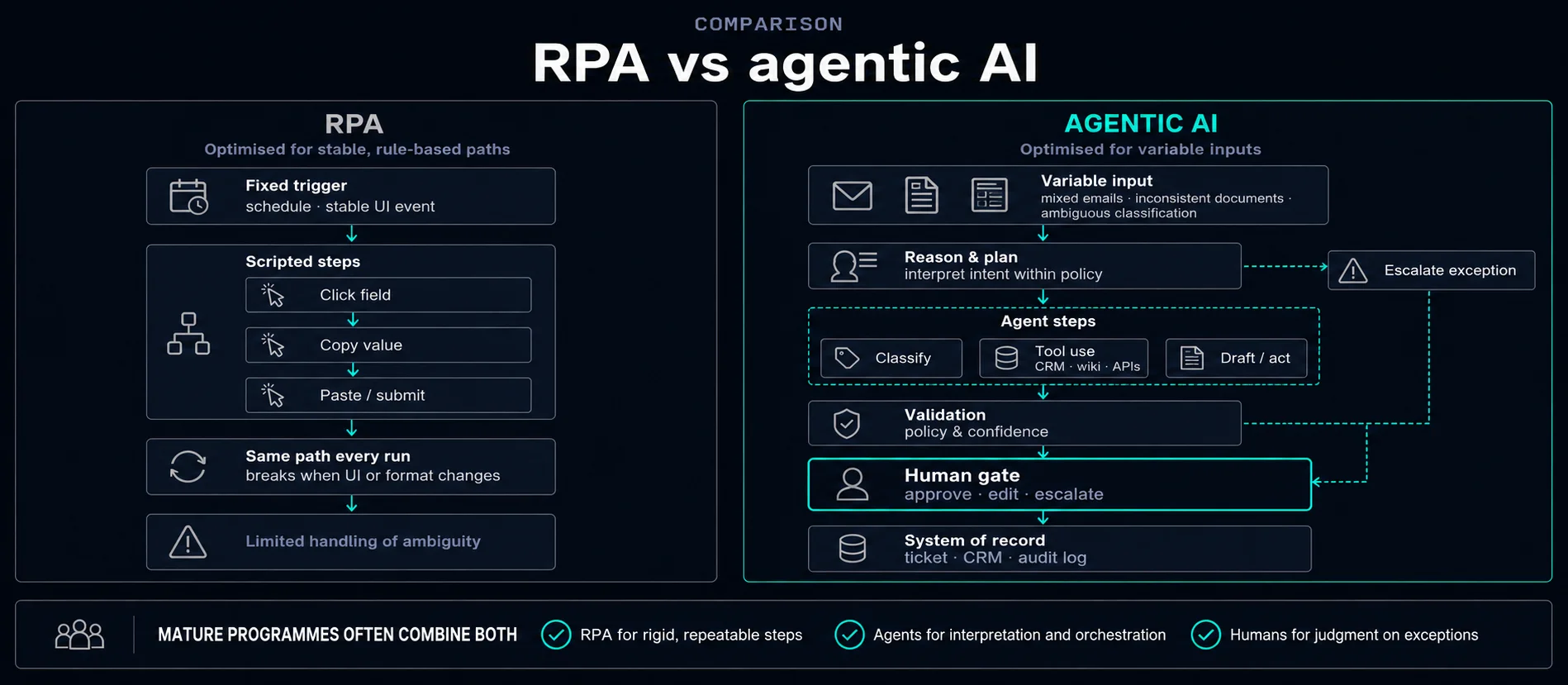
Robotic process automation (RPA) executes fixed scripts against stable user interfaces and data paths — field entry, copy, transfer, submission — where the process definition is consistent.
Agentic AI addresses higher variability: mixed correspondence, inconsistent documents, ambiguous classification. Because outputs are probabilistic, the control environment must be explicit: autonomy tiers, logging, escalation rules, and human gates on material actions.
In mature operating models, the two are frequently combined — RPA for rigid, repeatable steps; agentic orchestration for interpretation and coordination; accountable staff for judgment on exceptions.
Where organisations capture value
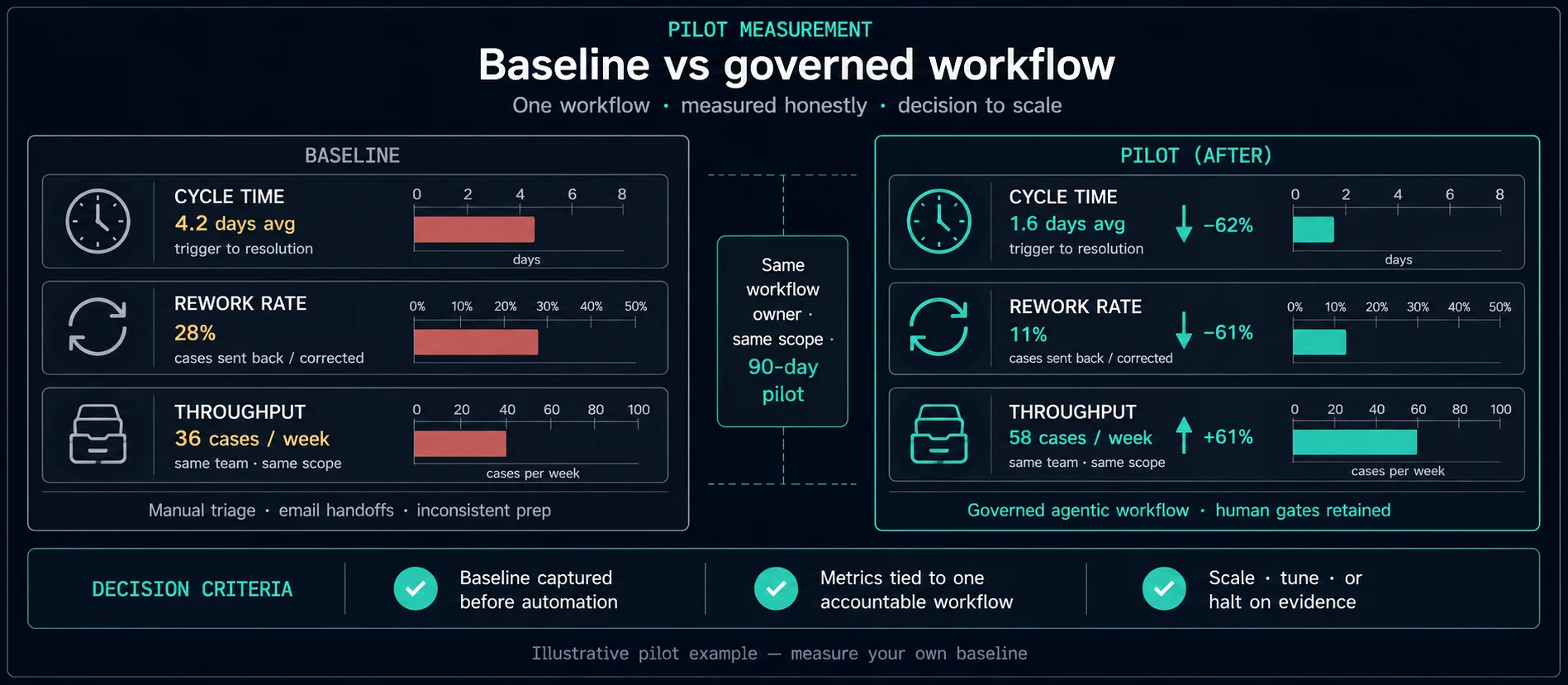
Value accrues when agentic AI is anchored to a defined workflow with measurable baseline and target performance — not as an abstract productivity narrative. Outcomes commonly observed on disciplined pilots include:
- Reduced manual triage — classification, routing, and first-draft preparation compress queue time; staff concentrate on exceptions.
- Improved handoff integrity — the workflow owns the next action in-system rather than via informal email chains.
- Higher throughput at constant headcount — more cases, shipments, assessments, or reviews completed per period, measured against an honest baseline.
- Accelerated assurance preparation — evidence collection and control progression advance faster; accountable owners still sign material outputs.
- Defensible audit trail — a record of what the automation executed, on what data, and who approved it — suitable for procurement, security review, and internal audit.
Representative domains include customer operations, finance and accounts payable, human resources and onboarding, security assurance, logistics and supply chain, product development, procurement, and regulatory compliance. The orchestration pattern is consistent; triggers, tools, human gates, and systems of record vary by context.
Extended terminology
As programmes mature, the following terms appear in architecture discussions and supplier evaluations. None is mandatory for a first pilot.
- Human-in-the-loop (HITL) — mandatory human review before customer-facing communication, financial commitment, or policy deviation.
- Tool use / function calling — structured invocation of approved APIs rather than model-generated assumptions presented as fact.
- Retrieval-augmented generation (RAG) — outputs grounded in authorised source material, with citation where the control environment requires it.
- Multi-agent workflow — multiple specialised agents coordinated by an orchestrator. Indicated when complexity warrants decomposition — see programmes at scale below.
- Evaluation harness — defined tests and metrics applied before and after change — a production requirement, not an optional enhancement.
Programmes at scale: coordinating dozens of specialist agents
The baseline example above may involve one agent, or a short chain of two or three. That is the appropriate starting point for most organisations. Agentic AI is not, however, confined to inbox triage — nor to a single industry or product pattern.
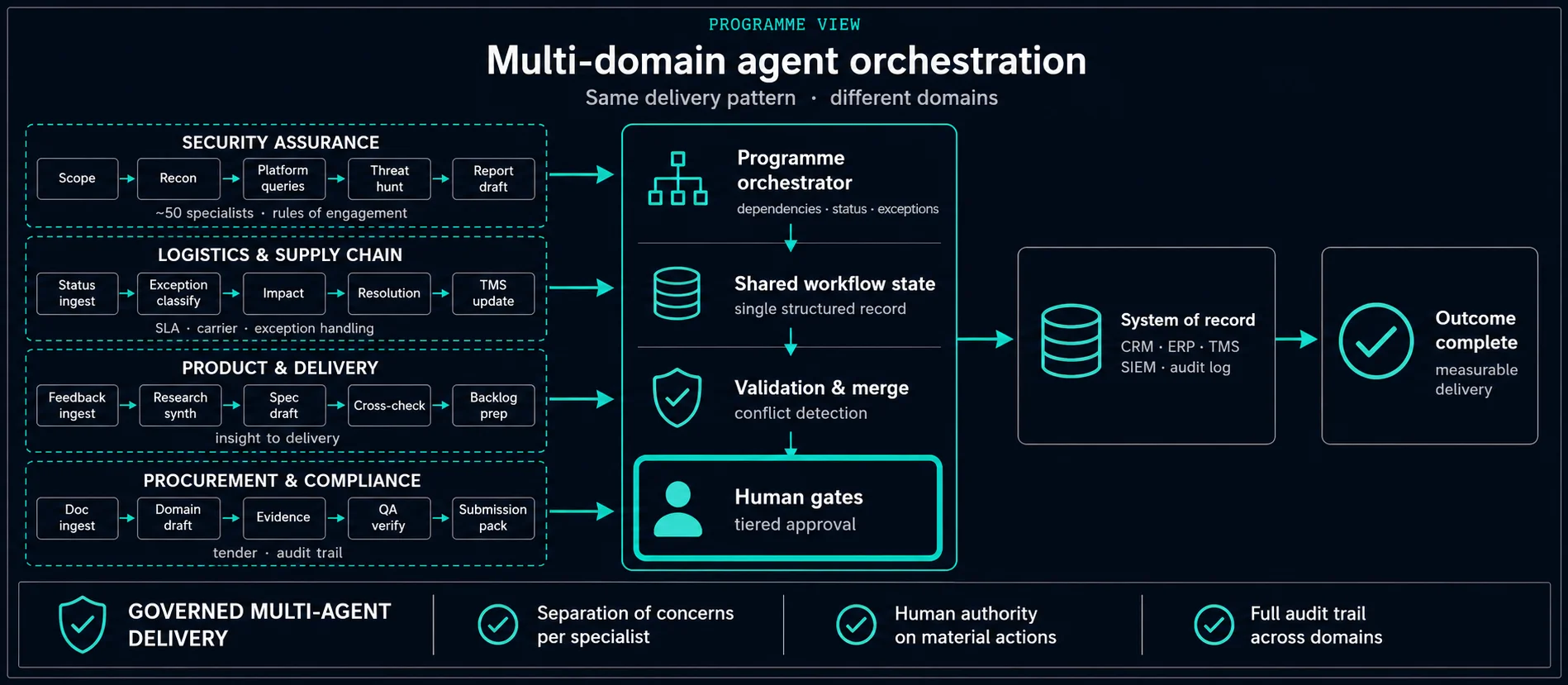
At programme scale, a single outcome may require forty, fifty, or more specialist agents operating in parallel: each with a narrow remit, coordinated through orchestration layers, and subject to human gates before any material or high-impact action. This is engineered delivery — shared state, explicit dependencies, and full auditability — not a collection of disconnected chat interfaces.
The same delivery discipline applies whether the domain is security assurance, logistics, product development, procurement, finance, customer operations, or compliance. Document-heavy and event-driven workflows often show returns first — that is a common entry point, not a boundary on where agentic AI applies.
Common orchestration structure
Large programmes decompose into consistent layers regardless of sector:
- Programme orchestration — master schedule, dependency management, status reporting, and exception routing to an accountable owner.
- Ingestion and normalisation — conversion of unstructured inputs (documents, events, alerts, tickets, telemetry) into structured workflow state.
- Domain specialists — narrow agents, each independently testable: defined remit, defined tool boundary, defined evaluation criteria.
- Tool connectors — governed integration with ERP, SIEM, CRM, TMS, ticketing, document management, and analytics platforms.
- Validation and merge layers — schema enforcement, conflict detection, confidence thresholds, and reconciliation prior to output combination.
- Tiered human gates — autonomy highest on low-risk preparation; reduced to zero on contractual, customer-facing, financial, or offensive-security actions.
- System of record — the authoritative log of activity, evidence, and approval.
Agent count increases where separation of concerns improves testability and control — not as an end in itself. Individual specialists can be evaluated without re-executing the entire programme.
Security assurance: governed penetration testing (~50 specialists)
A large penetration test or red-team engagement illustrates multi-agent delivery at scale. The work is inherently specialist-heavy, governed by rules of engagement, and unsuitable for undisciplined automation.
A structured programme may include:
- Scope and rules orchestration — in-scope assets, prohibited actions, time windows, and escalation paths established before execution.
- Reconnaissance and asset mapping — dedicated agents for external footprint, subdomain discovery, service fingerprinting, and cloud inventory — each writing to shared engagement state.
- Platform specialists — query and check generation per environment type (cloud posture, identity configuration, endpoint telemetry, application surface) rather than a single undifferentiated security agent.
- Threat-hunt and hypothesis agents — spawned from findings or intelligence leads; execute approved lines of enquiry; halt on low confidence or scope ambiguity.
- Correlation and chain analysis — cross-agent finding reconciliation, exploit-path ranking, false-positive filtering, and structured escalation for material impact.
- Reporting specialists — executive summary, technical appendix, remediation mapping, and retest criteria — each traceable to the evidence graph.
Engagements spanning multiple platforms and workstreams may reach approximately fifty specialists. Human gates precede active exploitation, client delivery, and any out-of-scope activity. Agents accelerate preparation, correlation, and drafting; accountable practitioners retain authority over live-system action and client-facing output.
Logistics and supply chain operations
In logistics and supply chain, triggers include delay, customs hold, capacity constraint, or customer escalation. A programme at scale may deploy:
- Agents per carrier, region, or lane normalising status feeds into a single case record.
- Exception classifiers routing delay, damage, documentation, or capacity events to the appropriate playbook.
- Impact analysts assessing downstream order, SLA, and production consequences.
- Resolution planners evaluating re-route, expedite, split-shipment, and communication options against cost and SLA constraints.
- Communications drafters producing customer updates from approved templates and live tracking data.
- ERP / TMS integrators — with human approval before fee-bearing commitments or contractual SLA amendments.
Product management and engineering delivery
Product-led organisations contend with fragmented input — support tickets, sales feedback, analytics, research repositories — and the coordination overhead of converting insight into delivered capability.
At scale, specialist agents may:
- Ingest and cluster feedback themes into a shared opportunity record.
- Produce research synthesis by product area — evidence summary, source linkage, signal strength assessment.
- Draft specifications and acceptance criteria from validated problems, with dependencies explicit.
- Run cross-functional checks against platform constraints, compliance requirements, and in-flight roadmap commitments.
- Generate stakeholder briefs for engineering, design, sales, and leadership from a single evidence base.
- Prepare backlog updates for Jira, Linear, or Productboard — with human gate before external commitment or roadmap publication.
Product leadership retains prioritisation authority and accountability for external commitments.
Procurement, finance, and compliance programmes
Document-intensive commercial and assurance workflows follow the same architecture:
- Framework tender and RFP response — ingestion, domain drafting, evidence retrieval, commercial alignment, verification, and submission packaging across multiple lots and workstreams.
- Financial operations — invoice coding, exception handling, reconciliation support, and month-end preparation, with human gates on material postings and policy exceptions.
- SOC 2, ISO, and regulatory compliance — control-domain agents retrieving evidence, identifying gaps, and routing exceptions; accountable owners sign auditor-facing narratives.
Explicit audit requirements make these well-documented examples. The orchestration model transfers to any multi-step programme with comparable complexity and accountability needs.
Coordination requirements
Without orchestration, agent proliferation creates operational risk. Production-grade coordination includes:
- Shared workflow state — requirements, findings, drafts, evidence links, open items, and approval status in one structured record.
- Dependency-aware scheduling — downstream agents execute only when upstream outputs meet defined stability thresholds.
- Conflict detection — structured exception when specialists produce incompatible outputs; no silent merge.
- Parallel execution with controlled merge points — concurrent activity reconciled against schema and business rules.
- Tiered human gates — domain leads, programme owners, and executive approvers at escalating levels of impact.
- Complete audit trail — agent action, input source, revision history, and approver identity — defensible under procurement, security, and internal audit scrutiny.
Governance at scale
Increased agent count demands increased control design — not reduced oversight:
- Autonomy tiers by agent class — broad latitude for research and drafting; restricted modes for offensive, financial, legal, and customer-facing agents.
- Evaluation harnesses per workstream — automated verification of coverage, format, citation, scope, and confidence prior to human review.
- Observability and intervention capability — pause, rollback, or halt without loss of audit history.
- Prohibition on silent cross-agent override — committed outputs merge only through validation layers.
These control patterns apply whether programmes are built in-house, with a systems integrator, or with an external delivery partner. Scale is earned through measured discipline — not through agent count alone.
Scale is not the starting point
Deploying dozens of agents on day one is a recognised failure mode. Mature programmes earn scale: establish one governed workflow, capture baseline KPIs, harden logging and controls, then decompose agents as volume and complexity require. Organisations at the outset should begin with the baseline example above and the implementation sequence below — or consult practical guidance for SME adoption.
Implementation sequence
Agentic AI should be treated as a repeatable delivery capability — not a demonstration. The sequence below reflects established practice, aligned with how we work and quality standards.
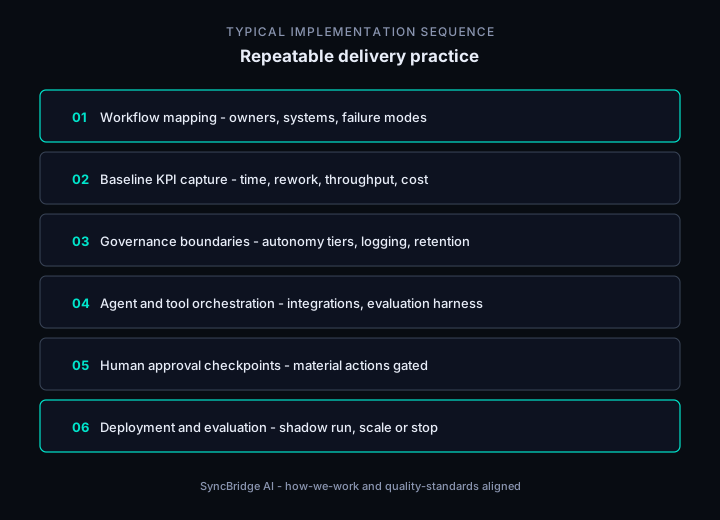
- Define one workflow — assign a process owner; document triggers, systems of record, exceptions, and completion criteria.
- Establish baseline performance — cycle time, rework, throughput, or cost per case prior to production traffic.
- Set governance boundaries — permitted unattended activity, mandatory human stops, and logging requirements.
- Integrate agents and tools — connect approved sources; implement validation and evaluation checks.
- Install human approval checkpoints — explicit gates on customer-facing, financial, and policy-sensitive actions.
- Deploy, measure, and decide — shadow or parallel run first; scale, refine, or terminate on evidence.
For measurement discipline, see KPIs for AI pilots that hold up in month three. For regional adoption context, see Agentic AI for Midlands SMEs and adoption, risk, and ROI.
Indicators of sound delivery
Whether delivered in-house or with a partner, effective programmes share common characteristics:
- Single-workflow focus initially — one accountable owner, one defined process, baseline metrics captured before build.
- Integration with systems of record — CRM, ERP, service desk, TMS, document stores — not shadow tooling.
- Risk-tiered autonomy — graduated permission on low-risk steps; hard stops on high-impact actions.
- Operational observability — logs, metrics, and defined rollback or pause capability.
- Governance artefacts — policies, runbooks, and evidence suitable for procurement and audit review. See AI governance and deployment.
Programmes fail when tooling precedes workflow definition, baselines, or ownership — regardless of who delivers them. For governance and deployment practice, see AI governance and deployment.
When agentic AI is not the appropriate first step
Agentic delivery is not universal. Reconsider priority if:
- The process lacks stable definition and changes materially week to week.
- Baseline performance cannot be measured today.
- Leadership mandates broad AI adoption without a named workflow owner.
- Data quality or ownership deficits exist — automation will amplify them.
In these circumstances, address instrumentation and accountability first — or commission a scoped diagnostic. See SME adoption sequencing and pilot measurement discipline.
Common follow-up questions
Once the definition is established, these are the questions that typically arise in board papers, architecture reviews, and vendor evaluations.
How is agentic AI different from Copilot-style assistants? Assistants help an individual within a session — drafting, summarising, or answering in context. Agentic AI orchestrates a multi-step workflow in your systems: tool use, validation, human gates, and updates to a system of record. One improves tasks; the other targets operational outcomes.
How is it different from a chatbot? A chatbot optimises for a conversational reply. Agentic AI optimises for a completed workflow with an auditable trail. See the definition above and the chatbot comparison section.
Is agentic AI the same as RPA? No. RPA follows fixed scripts on stable paths; agentic AI handles variable inputs with reasoning and tool use. Mature programmes often combine both. See the RPA comparison section above.
Do agentic systems run without humans? Not for regulated or customer-facing production work. Human-in-the-loop review, audit logs, and risk-tiered autonomy are standard; unattended runs are limited to low-risk steps with monitoring and rollback.
Is it appropriate for regulated environments? Yes — when explicit gates, logging, and human review apply to material outputs. Apply the same standard you would to any new operational system entering a controlled environment.
Which industries use agentic AI? Any organisation with multi-step, document- or event-driven workflows: security, logistics, product, customer operations, procurement, finance, and compliance. The orchestration pattern is consistent; tools, gates, and systems of record vary by domain.
Is a multi-agent platform required on day one? No. Begin with one governed workflow. Large programmes follow once baselines, ownership, and logging are established. See programmes at scale.
How does SyncBridge AI fit? UK-based consultancy and engineering: strategy, governed workflow delivery, and multi-agent programmes — Midlands and UK-wide, founder-led.
Further reading
Use this article as the definitional reference. Related material by topic:
- How it runs: Triggers, tools, and the agent loop
- Adoption and measurement: Where to start (Midlands SMEs) · Pilot KPIs · Adoption, risk, and ROI
- Domain depth: Tender workload measurement · Property sales progression workflows
- Delivery practice: How we work · Quality standards · Governance and deployment
- Regional context: Birmingham · Leicester · Midlands · Wolverhampton
- Consultancy: Agentic AI consultancy · Workflow automation · Book AI Consultation