// Use case · Leicestershire, Derbyshire, Nottinghamshire & Midlands
Tender response automation for UK SMEs — speed, structure & human approval
Stop losing weeks on PQQs and ITTs. This is an implemented tender workflow for your evidence library and approval process — not a self-service software login. We help UK SMEs move faster on bids without sacrificing quality: bid/no-bid support, requirement extraction, first-draft generation, and compliance checks — with human approval at every stage. In day-to-day language, tender is what most teams say; the pack may label it PQQ, SQ, ITT, or (in the private sector) RFP.
For measurement, bid discipline, and a sensible pilot sequence before you change tooling, read our Insights note SME tender and RFP workload: what to measure before you automate — it links back here and to the gated tender demo. For how human-initiated drafting fits the agent loop (tools, validation, gates), see How agentic workflows run.
For commercial RFQ and quoting (email, drawings, Sage handoff) rather than formal tender packs, see RFQ quoting automation for engineering SMEs.
This pattern is delivered through our workflow automation and agentic AI consultancy hubs — with governance & deployment for audit-ready logging and cloud AI solutions when you need hosted orchestration.
What this solution delivers
Practical support for SMEs that need to speed up bid work and keep governance — not software that submits tenders without your team in the loop.
- Faster bid decisions with structured bid/no-bid triage.
- Cleaner submissions through requirement extraction and evidence mapping.
- Higher-quality first drafts aligned to scoring criteria and word limits.
- Reduced risk with compliance checks before final sign-off.
Who this is for
- SMEs responding to UK tenders and large private bids — including heavy PQQ / SQ stages and RFP-style invitations — without a full-time bid team.
- Commercial and operations leads who need faster first drafts but stronger governance.
- Midlands businesses tracking opportunities across Find a Tender, Contracts Finder, and framework portals.
Common bid challenges it solves
- Too much time lost to manual tender triage and repetitive drafting.
- Knowledge trapped in old Word files, inboxes, and one key bid writer.
- Compliance misses caused by rushed reviews against marks, word counts, and mandatory questions.
- Inconsistent tone and evidence quality between bid submissions.
See the workflow in action
To access the Tender Command Centre simulation, click View demonstration. Users complete a company-email access step before entering the simulator.
Workflow overview
AI-powered procurement
Tender Response Workflow
UK tender packs — PQQ, SQ, ITT and RFP-style — faster bid decisions, stronger compliance, human-controlled outputs.
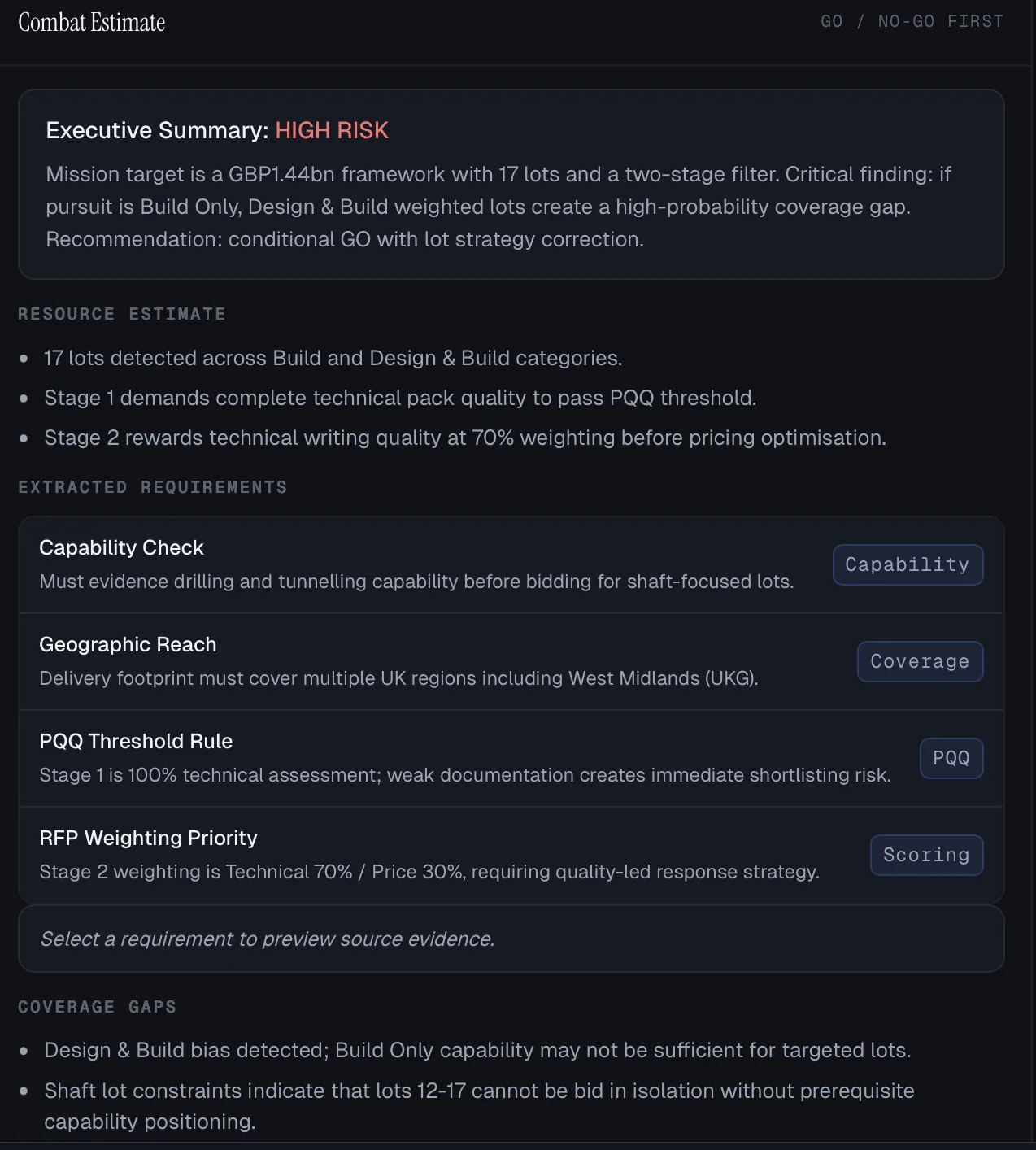
Simulator illustration: fast triage vs a manual first-pass review (not a production SLA or audited benchmark).
Ingest Tender Pack
Upload or connect tender packs — PQQ, SQ, ITT and RFP-style bundles — for automated parsing into a structured first pass your team can review.
From the Command Centre
How the workflow operates
- Bid/no-bid triage: parse tender packs — ITT, PQQ, SQ, and RFP-style documents — and score for fit, effort, and win likelihood.
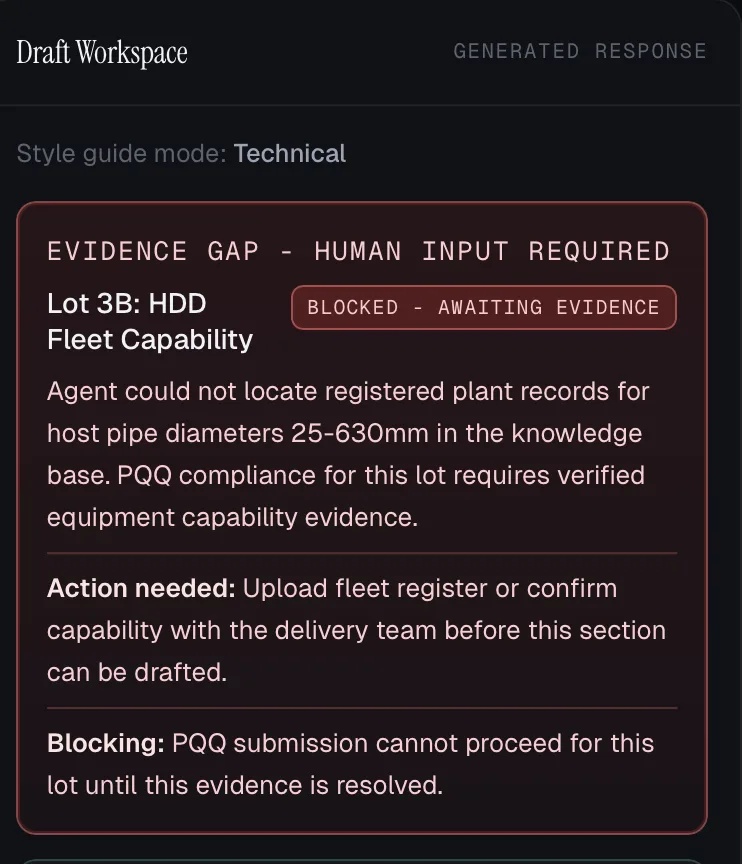
- Requirement extraction: pull out evaluation criteria, pass/fail requirements, and deadlines into a review matrix.
- Content matching: retrieve reusable evidence from your approved answer library and previous submissions.
- AI-assisted draft writing: generate first-pass responses aligned to question intent, word limits, and scoring criteria.
- Compliance and quality checks: flag gaps, weak evidence, and missing attachments before final review.
- Human sign-off: your bid owner approves and edits everything before submission.
Auto-versioning for bid responses and compliance
Bid teams rarely win on raw drafting speed alone — auditors and internal governance ask what changed, who approved it, and which evidence supported each answer. We design workflows so drafts evolve through named checkpoints rather than silent overwrites: retained iterations for scoring edits, attachment bundles, and clarification rounds.
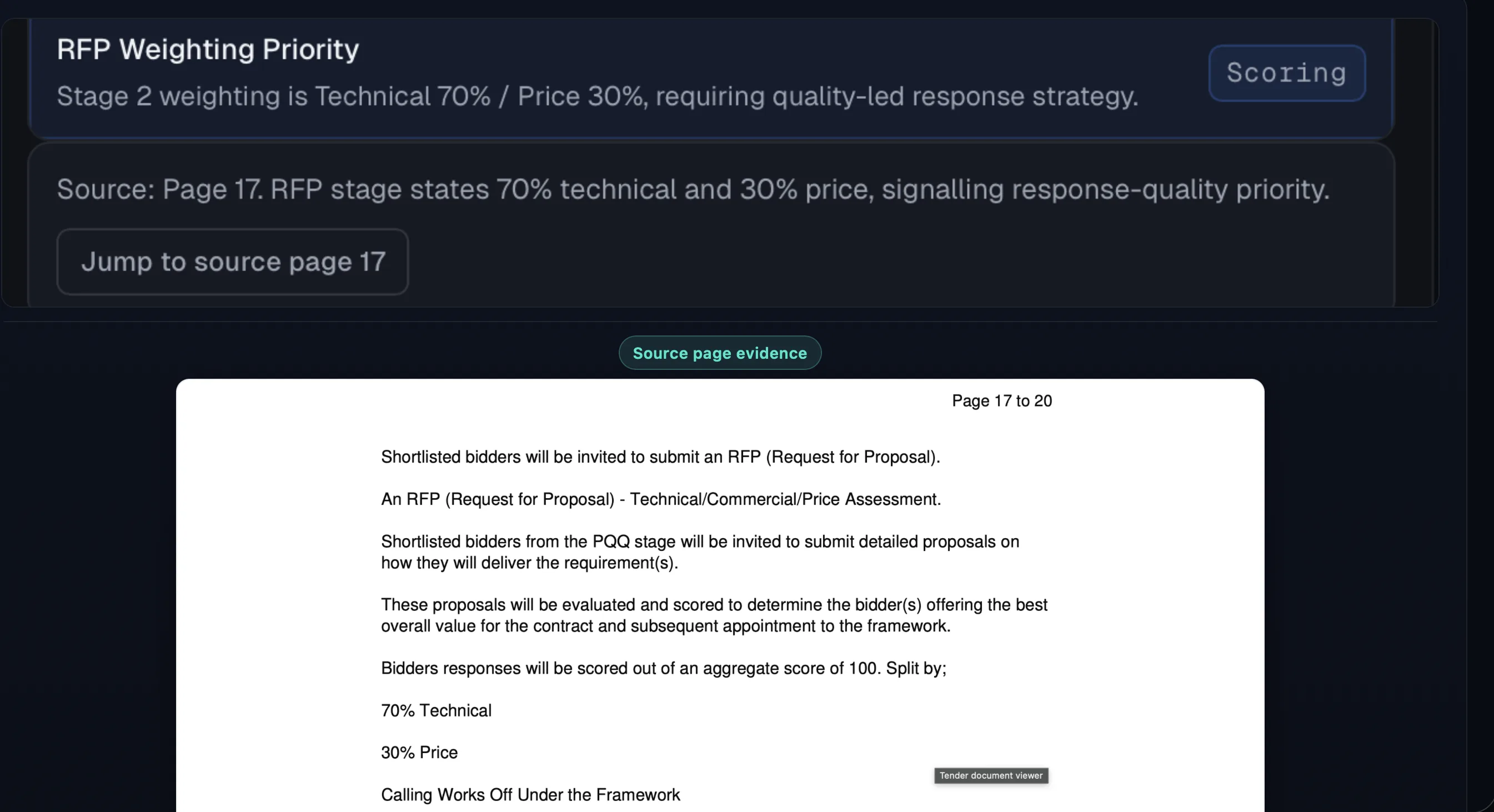
- Traceability: link answers back to tender clauses, prior submissions, and controlled boilerplate — reducing compliance drift between versions.
- Controlled updates: when buyer clarifications land late, propagate changes through a review queue instead of duplicating Word files.
- Compliance posture: keep an audit-friendly trail suitable for internal risk teams — distinct from autonomous submission.
Governance and guardrails
- No autonomous submission; humans remain accountable for every answer.
- Ground responses in approved source content to reduce hallucinations.
- Track evidence and rationale so reviewers can validate quickly.
- Separate draft generation from final legal/commercial sign-off.
Pilot scope: first 30 days
- Week 1: define one tender or bid shape you repeat (e.g. framework lot, recurring public tender, standard PQQ/SQ, ITT, or private RFP pattern) and import sample historic submissions.
- Week 2: set up triage logic, answer library, and review checkpoints.
- Week 3: run two or three real or redacted opportunities end-to-end.
- Week 4: measure draft turnaround, review effort, and compliance defect reduction.
Delivery trust and quality
Every workflow is scoped around measurable outcomes and reviewed by humans before high-impact actions. See how we work and our quality standards.
For adjacent governance-heavy bid workflows, see vendor security questionnaire prefill automation.