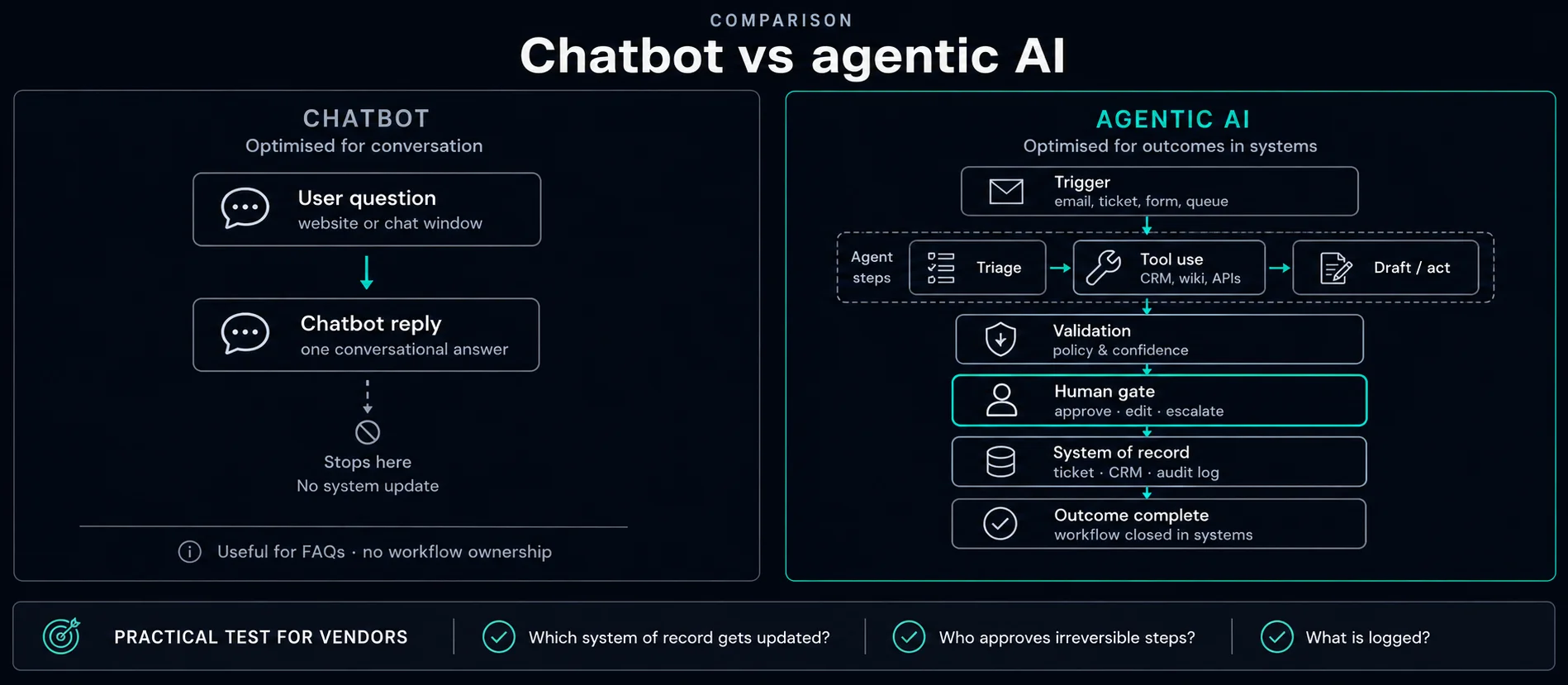
When familiar tools are enough
ChatGPT (Business or Enterprise) fits interactive work: a person leads the session, checks each output, and decides what ships. Connectors and governed deployments can reach into approved systems — still with a human in the loop for material actions.
Zapier (including Agents on supported plans) fits linear workflows between apps it already integrates: trigger → steps → optional human approval → log. If your process is mostly “when X happens in app A, update app B”, start there.
Microsoft Power Automate and similar iPaaS tools play the same role inside M365-heavy estates. We configure these first when they meet the requirement — see the comparison matrix and decision flow above.
When to engineer beyond them
Move to a bespoke or hybrid production workflow when you need any of the following:
- Persistent operational state — queues, cases, or jobs that survive across events and users
- Event-driven execution — schedules, webhooks, or system alerts that run without someone opening a chat window
- Non-standard systems — line-of-business tools, files, or APIs Zapier does not cover cleanly
- Custom permissions and UX — role-based views, exception desks, or approval surfaces your team already uses
- Exception handling — structured queues, SLAs, and rollback when automation is wrong
- Material facts without a reliable reviewer — pricing, compliance, or ERP fields where hallucinations or gaps must be caught by structure, not hope
- Unit economics at scale — per-run platform fees that exceed the cost of an in-house service
That is the boundary for our workflow automation and agentic AI consultancy work.
How SyncBridge engages
We start with the operational decision you need to improve, not a technology preference. Most engagements begin with a four-week production slice from £4,950: one workflow, one primary system, one human approval point, baseline metrics, and a scale-or-stop review. See how we work for what is included and quoted separately.
Examples on our solutions index illustrate the method. They are reference designs and demonstrations — not the limits of what we build.
ChatGPT and Zapier get most SMEs further than off-the-shelf tools usually do. When you hit the wall, the fix is rarely a cleverer prompt — it is owning the process as a system someone can explain and audit.
Frequently asked questions
Should we use ChatGPT or hire a consultancy?
Use ChatGPT when work is interactive and user-led. Engage SyncBridge when the operation must run as a governed system of record with measurable acceptance tests.
Is Zapier enough for AI workflow automation?
Often yes for supported linear flows. Engineer beyond it when state, integrations, or reliability requirements exceed what the platform can own cleanly.
Can we use ChatGPT and Zapier together?
Yes — many estates use both. The gap appears when neither layer owns persistent queues, exception handling, and SLAs as one operation. That is when a small engineered service (or hybrid) is worth scoping.